The Best Swaddles for Newborns: A Guide to Safe, Organic Sleep in 2026
Those early newborn weeks are beautiful and exhausting all at once. If your little one keeps waking themselves up with sudden arm flails, you're not doing anything wrong, that's the startle reflex, and it's one of the most common reasons newborns struggle to stay asleep. The right swaddle can make a world of difference, helping your baby feel snug, secure and settled for longer stretches. In this guide we'll walk you through everything from organic materials, hip-healthy design, TOG ratings for the Australian climate, and how to make those midnight nappy changes as easy as possible. You deserve more rest, and we're here to help you find it. 🌙
You aren't alone in wanting a solution that prioritises both safety and serenity. This guide will help you discover how to choose a swaddle that soothes the startle reflex, ensures hip-healthy positioning, and helps your baby sleep longer using breathable organic materials. We will walk you through the latest 2026 safety standards, the importance of avoiding weighted products, and how to manage nappy changes easily without fully unwrapping your little one. By the end, you'll have the confidence to create a secure sleep environment that supports your baby's growth and restores harmony to your home.
Key Takeaways
- Understand how replicating the womb's gentle pressure calms the startle reflex and supports your baby's transition through the fourth trimester.
- Learn why organic cotton is the best choice for sensitive skin and natural thermoregulation during hot Australian summers and chilly winters.
- Compare traditional wraps with modern sleep solutions to find a secure and escape-proof fit that supports your baby's sleep stage.
- Identify the specific design features of swaddles for newborns that promote healthy hip development and meet the latest 2026 safety standards.
- Discover how the Koala Hugs design is the only one of its kind that allows your baby to have longer stretches of sleep while keeping them comfort and security.
Table of Contents
-
Understanding the Fourth Trimester: Why Swaddles for Newborns are Essential
-
Choosing the Right Material: Why Organic Cotton is Non-Negotiable
-
The Baby Loves Sleep Difference: The Koala Hugs Newborn Swaddle
Understanding the Fourth Trimester: Why Swaddles for Newborns are Essential
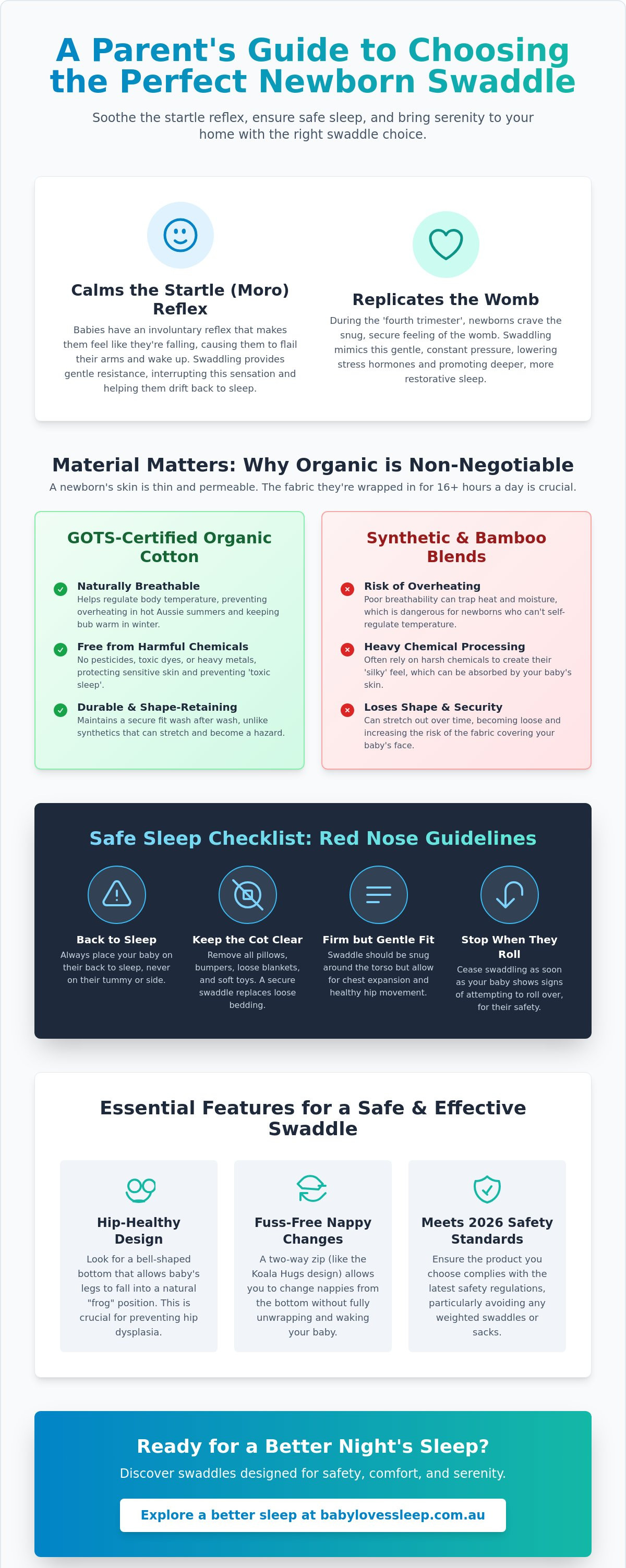
The first twelve weeks of your baby's life are often described as the fourth trimester. During this period, your newborn is navigating a massive transition from the warm, dark, and tight confines of the womb to a world that feels vast and unpredictable. This sudden change can be overwhelming for their developing nervous system. Using swaddles for newborns helps bridge this gap by providing the gentle, consistent compression they crave. This snugness mimics the feeling of being held, which naturally lowers cortisol levels and helps your little one feel secure enough to drift into a deeper sleep.
Beyond emotional comfort, swaddling serves a very practical purpose during active sleep cycles. Newborns often move their hands toward their faces, and without containment, those tiny, razor-sharp fingernails can cause accidental scratches. By keeping their arms tucked safely away, you aren't just helping them stay asleep; you're protecting their delicate skin. This ancient practice of swaddling has evolved into a modern essential that supports both the physical and neurological needs of your growing baby.
The Moro Reflex: Why Your Baby Wakes Up Suddenly
Have you ever watched your baby sleep, only to see them suddenly flail their arms out as if they've been startled? This is the Moro reflex, an involuntary reaction to a perceived sensation of falling. It is a primitive survival mechanism that typically peaks within the first 12 weeks of life. Because newborns don't yet have control over their limbs, these jerky movements often wake them up just as they've finally settled. Arm containment provides the necessary sensory feedback to stop this flailing. When their arms meet the soft resistance of the fabric, the "falling" sensation is interrupted, allowing them to drift back to sleep. Most babies naturally outgrow this reflex by the time they are 4 or 5 months old.
Creating a Safe Sleep Environment for Aussie Babies
Safety is the foundation of every rest period. In Australia, Red Nose guidelines emphasise the importance of a clear cot and a firm, flat sleep surface to reduce the risk of SIDS. A secure swaddle is a key component of these "Back to Sleep" recommendations because it removes the need for loose blankets in the nursery. Loose bedding is a significant hazard as it can easily shift and cover a baby's face, potentially obstructing their breathing. When you choose high-quality swaddles for newborns, you ensure the wrap stays in place all night. This gives you the peace of mind that your baby is warm and settled without the dangers associated with traditional loose sheets or heavy quilts.
-
Always place your baby on their back to sleep.
-
Ensure the swaddle is firm but allows for natural chest expansion.
-
Keep the cot free of pillows, bumpers, and soft toys.
-
Stop swaddling as soon as your baby shows signs of attempting to roll.
Choosing the Right Material: Why Organic Cotton is Non-Negotiable
Newborns have incredibly thin, permeable skin that absorbs what it touches far more readily than adult skin. Because your little one spends upwards of sixteen hours a day wrapped up, the quality of the fabric is just as important as the design of the wrap itself. Choosing organic cotton for swaddles for newborns ensures that no harsh pesticides, heavy metals, or toxic dyes come into contact with your baby. This commitment to chemical-free materials prevents "toxic sleep," where a baby might inhale or absorb synthetic residues throughout the night.
High-quality organic cotton also offers unmatched durability. Unlike synthetic blends that can lose their elasticity or become "bubbly" after a few cycles in the wash, premium cotton holds its shape. This is a vital safety factor; a swaddle that maintains its structural integrity ensures the wrap remains secure and doesn't become loose or hazardous over time. Investing in a high-quality organic cotton swaddle provides peace of mind, knowing the fabric is as resilient as it is gentle.
Organic Cotton vs Synthetic Blends
Many parents are tempted by the silky feel of synthetic blends or bamboo-polyester mixes. However, these fabrics often rely on heavy chemical processing and lack the natural breathability of cotton. Newborns cannot regulate their own body temperature effectively, making them prone to overheating if their clothing traps moisture. Organic cotton is naturally sweat-wicking; it allows air to circulate freely, which is essential for babies prone to eczema or heat-induced skin irritation. While following safe swaddling guidelines, the material you select plays a silent but vital role in your baby's comfort and health.
Understanding TOG Ratings for the Australian Climate
In Australia, we face unique challenges with temperature fluctuations. A TOG (Thermal Overall Grade) rating helps you understand how much warmth a swaddle provides. For our hot summers, a low TOG rating (between 0.2 and 0.4) in breathable cotton is ideal to prevent heat stress. During winter, you can layer a singlet or growsuit underneath rather than switching to heavy, non-breathable blankets. Using swaddles for newborns with appropriate TOG ratings ensures your baby doesn't wake up from being too cold or too hot.
Always check your baby's chest or the back of their neck to gauge their temperature. If you notice damp hair, a heat rash, or red cheeks, they are likely too warm. Organic cotton allows for easy layering, ensuring your baby stays in the "goldilocks" zone of comfort regardless of the season. This versatility makes organic cotton a non-negotiable staple for any Aussie nursery.
Swaddle Blankets vs Swaddle Sacks: Finding the Best Fit
Choosing the right mechanics for your baby’s sleep space is just as vital as the fabric. While many of us start with a stack of beautiful muslin squares, the reality of the midnight re-wrap often leads parents toward more structured options. When looking at swaddles for newborns, you'll likely find yourself choosing between a traditional flat blanket and a modern swaddle sack. Both have their place, but understanding the functional differences helps you decide which will actually help your household get more rest.
Traditional wraps offer a customisable fit. You can adjust the tension exactly where your baby needs it most. However, many new parents find the "origami" required to secure a flat sheet both stressful and difficult to master under the pressure of a crying infant. The biggest concern with traditional blankets is the risk of them coming undone. If a baby wriggles free, the loose fabric becomes a hazard in the cot, potentially covering their face and obstructing their breathing. This lack of security often leads to a "jack-in-the-box" effect where the baby's arms pop out, triggering the startle reflex and ending the sleep session prematurely.
The Pros and Cons of Traditional Swaddle Wraps
A flat wrap is undeniably versatile. It can serve as a pram cover, a nursing shield, or a play mat in a pinch. However, the steep learning curve means that even a slightly loose wrap can result in "loose ends" by morning. For an "escape artist" baby, these blankets rarely stay secure. This inconsistency is why many families transition to structured sleep sacks. They provide a reliable level of containment without the risk of fabric riding up over the baby’s mouth, which is a common worry for parents using traditional sheets.
Why Swaddle Sacks are the Modern Parent’s Favourite
Modern swaddle sacks have revolutionised the nursery for a reason. They offer a "zip and go" simplicity that is invaluable during those blurry, sleep-deprived night shifts. One of the most practical features is the two-way zipper. This allows for easy midnight nappy changes by opening only the bottom of the sack. You can keep the baby’s arms snugly contained and their torso warm while you deal with the nappy. This minimal disruption often means the baby drifts back to sleep much faster because they haven't been fully unwrapped or chilled.
Beyond convenience, baby sleep sacks provide a consistent fit every single time. There is no guessing whether it is too tight or too loose as long as your baby has the correct size. Most importantly, high-quality sacks are designed with hip-healthy swaddling in mind. They provide the necessary compression around the chest to soothe the startle reflex while allowing the legs to fall into a natural "frog" position. This balance of security and physiological freedom is why many experts recommend infant sleep sacks over loose traditional wraps for long-term sleep success. Using swaddles for newborns that combine zipper security with the snugness of a wrap gives you the best of both worlds, ensuring your little one stays safe and settled until morning.
Key Features of a Safe and Hip-Healthy Swaddle
While we often focus on the upper body to calm the startle reflex, the lower half of the swaddle is just as critical for your baby's physical development. Many traditional methods of using swaddles for newborns involve wrapping the legs tightly and straight down. However, this positioning can interfere with the natural development of the hip joints. Newborns are born with soft, flexible cartilage, and if their legs are forced into a straight position for long periods, the ball of the hip joint can slip out of its socket. This condition, known as hip dysplasia, is a significant concern that every parent should be aware of when choosing sleepwear.
The International Hip Dysplasia Institute (IHDI) provides clear guidance on what makes a swaddle safe. A truly hip-healthy design allows the baby’s legs to remain in a "frog-leg" position, where the hips are flexed (bent up) and abducted (turned out). This natural posture ensures the hip joint stays securely in its socket, promoting healthy growth. This is why the bottom half of any swaddle must be bell-shaped or sufficiently roomy; it gives your baby the freedom to move their legs without restriction while they rest.
Recognising a Hip-Healthy Design
When shopping for swaddles for newborns, look for a wide, pouch-like base rather than a narrow "mermaid" tail. You should be able to feel that your baby can fully retract their legs into a bent position inside the fabric. A simple way to remember this is the "tight at the top, loose at the bottom" rule. The chest and arms should feel secure to provide that womb-like comfort we discussed earlier, but the hips and knees must have plenty of kick space to move freely. This mechanical "why" behind the design is what prevents long-term developmental issues.
When to Worry: Signs of Hip Issues in Newborns
Even with the best swaddling practices, it's important to stay vigilant. Watch for asymmetrical leg creases or any "clicking" or "clunking" sounds when you move your baby's legs during nappy changes. These can be early indicators of joint issues. Your 6-week paediatric check-up is a vital milestone where a professional will specifically screen for these signs. By choosing a design that respects infant anatomy, you are actively supporting your baby's healthy joint development from day one.
If you want a swaddle that balances arm security with the freedom your baby’s hips need, explore our hip-healthy swaddle collection designed to support every milestone.
The Baby Loves Sleep Difference: The Koala Hugs Newborn Swaddle
As an Australian-owned brand, Baby Loves Sleep was born from a place of deep empathy for the physical and emotional exhaustion that defines early parenthood. Our founder, a mum who navigated the same sleepless nights you are currently facing, realised that the market lacked a solution that truly balanced security with physiological safety. When we developed our swaddles for newborns, we focused on the mechanical "why" behind infant sleep disruptions. The result is the Koala Hugs Newborn Swaddle, a design that replicates the gentle, reassuring pressure of a parent's embrace to help your baby settle faster and stay asleep longer.
Our commitment to quality means we only use organic cotton, ensuring that every garment is free from the harsh chemicals often found in mass-produced baby gear. This choice isn't just about softness; it's about creating a safe, non-toxic environment where your baby's skin can breathe. We also prioritise ethical manufacturing and sustainability, so you can feel confident that your purchase supports fair labour practices and a healthier planet for your child's future. By choosing the Koala Hugs Newborn Swaddle, you are investing in a premium sleep tool designed by people who truly understand the struggle.
Why Koala Hugs is the Premium Choice for Aussie Mums
The unique "hug" sensation of our swaddle provides the consistent compression needed to calm a fussy newborn. We know that 2 AM wake-ups are difficult enough, so we've included clever secret arm pockets. You don't have to worry about complex folds or velcro that loses its grip after a few washes. The organic cotton we use is specifically chosen for its ability to wick away moisture, ensuring your baby stays dry and comfortable even during a humid Queensland summer night. These thoughtful design elements work together to restore harmony to your household.
Planning for the Future: The Milestone Sleep Journey
We don't just sell swaddles for newborns; we provide a roadmap for your baby's changing developmental needs. As your little one grows and begins to show signs of rolling, their sleep requirements will shift. This is why we created a milestone-based system that guides you from the first days of life through the toddler years. Once your baby outgrows the need for full arm containment, you can move seamlessly to our Sleepy Hugs Transition Sleep Sack. This allows for a safe and gentle transition that maintains that familiar sense of security while giving them the freedom they need to move safely.
Beyond the newborn stage, we are here to be your reliable partner in every sleep transition. Our goal is to provide peace of mind through innovative designs that grow with your family. Give your newborn the gift of a Koala Hugs today and start your journey toward longer, safer, and more restful nights for everyone.
Embracing Restful Nights for Your Growing Family
Navigating the first few months of parenthood is a journey of discovery and often, deep exhaustion. By understanding the mechanical needs of the fourth trimester, you can transform those unsettled nights into periods of calm growth. Choosing swaddles for newborns that prioritise organic cotton ensures your baby stays comfortable in our unique Australian climate while avoiding harsh chemicals. Most importantly, selecting a design acknowledged by the International Hip Dysplasia Institute gives you the peace of mind that your little one’s physical development is protected during every sleep session.
Our Australian owned and designed range is built on the shared experience of parents who have been exactly where you are. We believe that when your baby sleeps better, your whole household can begin to thrive again. You don't have to settle for "just enough" rest when a safer, more nurturing solution is available to support your baby's milestones.
**Shop the Koala Hugs Organic Newborn Swaddle Range ** and discover the difference a thoughtful design makes to your baby's rest. You are doing an incredible job, and more restful nights are just around the corner.
Frequently Asked Questions
How long should I swaddle my newborn for each day?
You should swaddle your newborn for every sleep period, including daytime naps and overnight rest, to help them feel secure. However, it's vital to provide plenty of unswaddled time when your baby is awake and supervised. This allows them to move their limbs freely, explore their environment, and develop the gross motor skills necessary for their physical growth. Balancing secure sleep with active wake time is the best way to support their overall development.
Is it safe to swaddle a baby with hip dysplasia?
It is safe only if you use a swaddle specifically designed to accommodate a hip harness or one that allows for complete leg freedom. Traditional tight wrapping can worsen the condition by forcing the legs into a straight position. If your little one is being treated, we offer specialised Hip Harness Sleep Suits that provide the necessary room for their legs to remain in the required "frog-leg" position while still offering the comfort of a wrap.
Can my baby sleep in a swaddle if they are starting to roll over?
You must stop using traditional swaddles for newborns as soon as your baby shows any signs of attempting to roll over. This is a critical safety milestone because a swaddled baby who rolls onto their tummy cannot use their arms to push themselves up, which increases the risk of suffocation. At this stage, it's time to transition to a Sleepy Hugs Transition Sleep Sack to keep them safe and settled while allowing for greater arm movement.
What is the best TOG rating for a swaddle in an Australian summer?
A 0.2 TOG rating is the gold standard for swaddling during the Australian summer. This lightweight, breathable fabric helps prevent overheating when nursery temperatures rise. Pair this with a simple nappy or a light cotton singlet underneath to ensure your baby stays in a comfortable temperature range. Always monitor your baby for signs of heat stress, such as damp hair or a sweaty chest, even when using lightweight materials.
How many swaddles does a newborn actually need?
Most parents find that having three swaddles is the ideal number to manage the realities of newborn life. This allows for one in use, one in the wash, and one clean spare for those inevitable midnight nappy leaks or spit-ups. Having a small rotation ensures you are never caught without a secure sleep solution when your baby is tired and needs to settle quickly, especially during those first few blurry weeks.
My baby keeps breaking their arms out of the swaddle, what should I do?
If your baby is an "escape artist" who constantly breaks free, you should switch from a traditional wrap to our Koala Hugs newborn swaddle to ensure your baby's arms stay snugly contained throughout the night. This prevents them from waking themselves up with the startle reflex while eliminating the hazard of loose blankets becoming untucked and shifting in the cot, which can be a significant worry for parents.
Can I use a swaddle blanket and a swaddle sack together?
You should never use a swaddle blanket and a swaddle sack at the same time. Layering these products creates a significant risk of overheating, as newborns cannot regulate their body temperature effectively. Instead, choose a single, high-quality swaddle with the appropriate TOG rating for your room temperature. If it's a chilly night, it's much safer to add a layer of clothing, like a growsuit, underneath the swaddle rather than adding extra wraps on top.
How do I know if the swaddle is too tight around my baby’s chest?
You should be able to slide two to three fingers easily between the swaddle fabric and your baby's chest. This ensures the wrap is snug enough to provide security but loose enough to allow for full chest expansion and comfortable breathing. While the chest should feel firm, the bottom half of the swaddle must remain roomy enough for your baby to bend their legs up and out at the hips, ensuring their joints develop naturally.
Article researched and written by Malou Villarreal, Founder Baby Loves Sleep and INPAA Baby Safety Ambassador.