
What is Dream Feeding Infants? The Aussie Parent’s Guide to More Sleep
What if you could sneak into your baby’s nursery at 10:00 PM and give them a snack without actually waking them up? It sounds like a high-stakes stealth mission, but many exhausted Aussie parents are asking what is dream feeding infants as a potential solution to those brutal 2:00 AM wake-up calls. We understand that bone-deep exhaustion where you would almost trade your favourite coffee machine for just four consecutive hours of shut-eye. It is completely normal to feel like touching a sleeping baby is like playing Jenga with a very loud, very tired tower of blocks, but it does not have to be that way.
This guide will show you how to master the dream feed to align your baby’s sleep with your own and finally reclaim those precious extra hours of rest. We know you are tired of conflicting advice, so we have simplified the process to give you back your confidence. We will look at the best timing for a feed, how to keep bub snug and settled in their Koala Hugs Newborn Swaddle during the process, and the signs that your little one is ready for a longer stretch of sleep.
Key Takeaways
- Understand what is dream feeding infants and how this strategic late-night snack helps align your baby’s longest sleep stretch with your own.
- Learn why the "golden window" between 10 PM and 11 PM is the best time to feed bub before you head to bed yourself.
- Discover the secrets to staying in "stealth mode," including keeping the lights low and skipping the nappy change to avoid fully rousing your little one.
- See how the right sleepwear, like the Koala Hugs Newborn Swaddle, uses organic cotton to keep bub snug and prevents the Moro reflex from ruining the transfer back to the cot.
- Get practical advice on handling common hiccups like false starts so you can reclaim your evenings and your sanity with confidence.
Understanding the Dream Feed: A Lifeline for Sleep-Deprived Parents
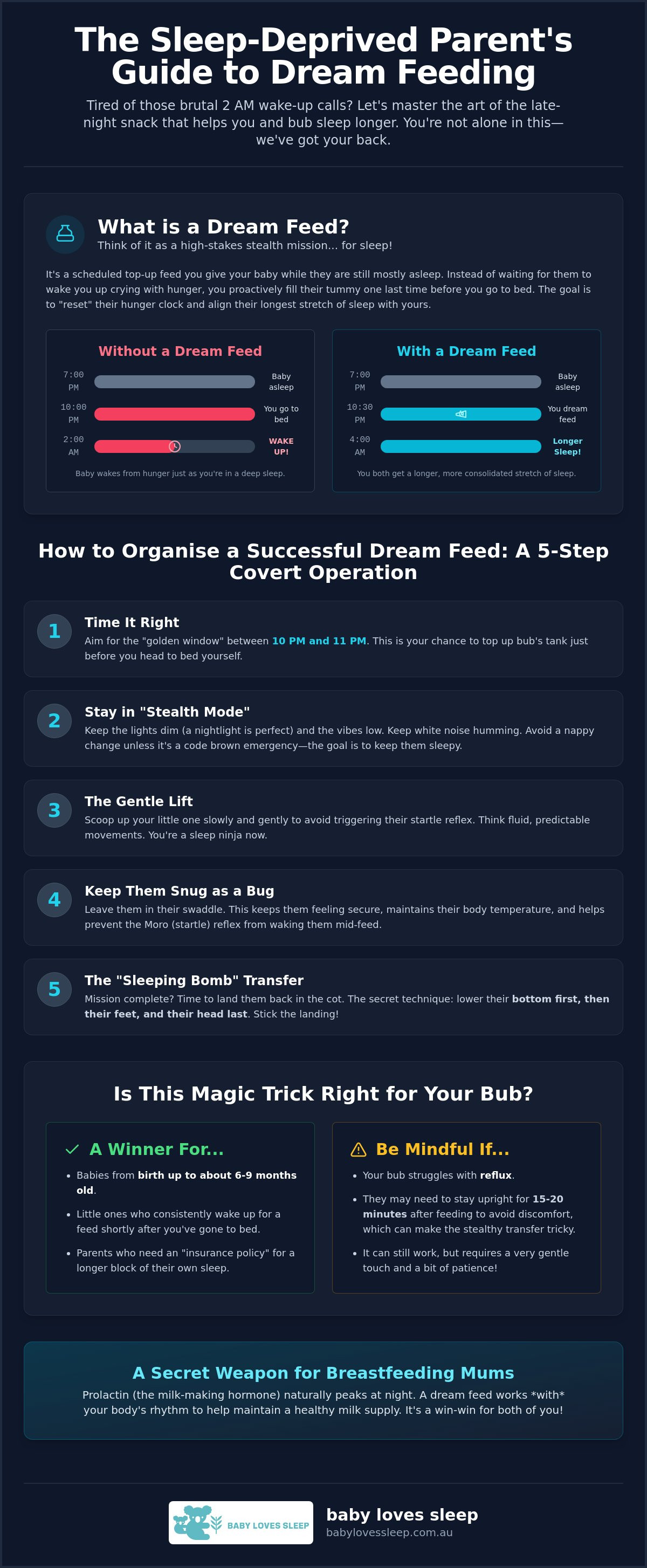
If you have ever found yourself staring at the ceiling at 2:00 AM, wondering how such a tiny human can have such a massive impact on your sanity, you are not alone. Many parents ask what is dream feeding infants because they are desperate to break the cycle of the "zombie walk" across the hallway. Simply put, a dream feed is a scheduled top-up given to your baby while they are still asleep, usually between 10:00 PM and midnight. When you are researching what is dream feeding infants, you will find it is about being proactive rather than reactive. The goal is to fill their tummy one last time so their longest stretch of sleep aligns with your own, giving you a solid block of rest before the sun comes up. It is a game-changer for household harmony.
The effectiveness of this method relies heavily on infant sleep patterns. Babies spend a significant amount of time in active sleep, where they can feed effectively without fully rousing. It is a biological loophole that allows you to provide nourishment while keeping the "sleepy vibes" intact. You are essentially "resetting" their hunger clock while they stay in the land of nod, allowing them to bypass that traditional midnight wake-up call. It works because the sucking reflex is so strong that it functions even when the brain is mostly switched off for the night.
Is Dream Feeding Right for Your Bub?
This technique is generally a winner for babies from birth up until about six to nine months. You might find it particularly helpful if your little one has a habit of waking up just thirty minutes after you have finally crawled into bed. It is for the parents who need that extra "insurance" policy for their own rest. However, if your bub struggles with reflux, you will want to be a bit more careful. Reflux babies often need to stay upright for 15 to 20 minutes after eating, which can be tricky to manage without waking them up entirely. If you can master the "slow transfer" back to the cot, it can still work, but proceed with caution and keep those burp cloths handy.
The Prolactin Connection: A Win for Breastfeeding Mums
For breastfeeding mums, this late-night session is a secret weapon. Prolactin, the hormone responsible for milk production, naturally peaks during the night. By offering a feed during this window, you are working with your body’s natural rhythm to maintain a healthy supply. It is often a very peaceful, quiet time that feels less like a chore and more like a gentle, sleepy cuddle. Because the house is quiet and the lights are low, bub is more likely to latch efficiently without the distractions of the daytime. Just keep the interaction minimal and the room dark to ensure they don't think it is time for a 11:00 PM play session.
The Practical Guide: How to Organise a Successful Dream Feed
Executing a dream feed is a bit like a covert operation; you want to get in, deliver the goods, and get out without anyone being the wiser. When you are looking into what is dream feeding infants, the "how" is just as vital as the "why." You are aiming for a seamless transition from cot to lap and back again. If you can master these five steps, you are well on your way to a more restful night. It takes a bit of practice, but soon you will be doing this with your eyes half-closed too.
- Step 1: Time it right. Aim for 10:00 PM to 11:00 PM. This is usually the sweet spot just before you head to bed yourself.
- Step 2: Keep the "vibes" low. Do not turn on the big light; a dim nightlight or the hallway glow is plenty. Keep the white noise humming and avoid a nappy change unless it is an absolute "code red" emergency.
- Step 3: The gentle lift. Scoop bub up slowly to avoid triggering the startle reflex. Movement should be fluid and predictable.
- Step 4: Keep them snug. Leave them in their swaddle, such as the Koala Hugs Newborn Swaddle. This maintains their body temperature and keeps them feeling secure while they drink.
- Step 5: The "sleeping bomb" transfer. When returning them to the cot, lower their bottom first, then their feet, and finally their head. It is the gold standard for a successful landing.
To Burp or Not to Burp?
This is the great parental debate. If your baby is prone to wind, a quick, gentle burp is necessary to prevent a 2:00 AM wake-up from tummy pain. Instead of vigorous patting, try holding them upright against your shoulder for a few minutes. If they have fallen into a deep "milk coma," sometimes the vertical position alone is enough to let air escape naturally. If you need more tips on settling techniques, you can get better sleep by following our milestone-based guides.
Bottle vs. Breast: Does it Matter?
Both work beautifully for a dream feed. If you are bottle-feeding, keep the teat full of milk to prevent them from swallowing air. The beauty of the bottle is that a partner can take over this shift, allowing mum to get an earlier start on her own rest. If you are breastfeeding, keep the room dark and the interaction minimal. Whether you use a bottle or a breast, the key to what is dream feeding infants is keeping the experience as boring as possible for the baby so they drift straight back into their next sleep cycle.
Common Hiccups: Why the Dream Feed Might Not Be Working (Yet)
Sometimes, despite your best "Mission Impossible" moves, the dream feed does not immediately result in that glorious eight hour stretch you were dreaming of. If you are still figuring out what is dream feeding infants and why it is not working for your specific household, do not throw in the towel just yet. It is quite common for the first few nights to feel a bit clunky. You might worry that you are creating a permanent "crutch," but remember that this is a strategic tool designed to help everyone get more rest, not a life sentence. It is a phase, much like your current relationship with dry shampoo.
One common issue is the "false start," where bub wakes up thirty minutes after you have tucked them back in. This often happens if the feed was too stimulating or if they have associated the feed with needing help to fall back into a deep sleep. Consistency is your best friend here. We recommend giving any change to the routine at least three to five nights before deciding it is not for you. Your baby’s brain needs a few repetitions to realise that this 10:30 PM snack is the signal for a long, uninterrupted snooze. If they continue to wake up more frequently after the feed, it might be a sign that you are accidentally disrupting their natural deep sleep cycle, in which case a slightly earlier or later time might be the fix.
Troubleshooting a Sleepy Eater
If your little one is so zonked they won't even open their mouth, try the "tickle the lip" trick with the nipple or teat. This usually triggers the rooting reflex without needing to wake them up. If they are still completely out of it, you might need to do a very quick, very boring nappy change before the feed to slightly rouse them. Active sleep is a lighter stage of rest where your baby might twitch or make little sounds, making it the perfect moment to offer a feed without fully waking them. Understanding what is dream feeding infants means learning to spot these tiny cues.
When to Drop the Dream Feed
Eventually, you will reach a point where the dream feed is no longer needed. You will know it is time when bub starts pushing the bottle away, or if they stop waking for their usual early morning feed on their own. You can either stop "cold turkey" or try the "tapering" method by gradually reducing the amount of milk offered each night over a week. As they grow and start moving more, you might also find they need a change in their sleep environment. This is a great time to look into gentle swaddle transitioning to ensure they stay comfortable as their needs change.
If you are ready to find the right gear for every stage of this journey, explore our full range of Australian designed sleep solutions to help your whole family rest easier.
Setting the Scene: Sleepwear and Environment for a Seamless Feed
When you are looking into what is dream feeding infants, it is easy to focus entirely on the milk and the timing. However, the physical environment and what your baby is wearing play a massive role in whether that transfer back to the cot is a success or a total "reset to factory settings" disaster. To keep bub in that deliciously drowsy state, you need to manage their sensory input. This starts with choosing the right fabrics. Organic cotton is the gold standard for late-night feeds because it is incredibly breathable. It prevents your little one from overheating while they are snuggled against your warm body, which is a common reason for babies to rouse fully during a feed.
The Koala Hugs Newborn Swaddle is a vital piece of kit for this mission. Its clever design keeps those little arms secure, which is the best way to prevent the Moro reflex from kicking in the moment you try to lean over the cot. There is nothing quite like the heartbreak of a successful feed being ruined by a sudden startle just as their bottom hits the mattress. As your baby grows and begins to show signs of rolling, you can transition to the Sleepy Hugs transition sack. This allows for a bit more movement while still providing that "hugged" sensation that is so important for babies who still need a late-night top-up to get through the night.
The "Womb-Like" Security Factor
A secure swaddle does more than just pin down flailing limbs; it mimics the constant pressure of the womb. This provides a sense of security that helps bub stay calm even when they are being moved. By reducing the "transfer shock" from your warm, snuggly arms to the relatively cool cot sheets, you increase your chances of a successful "stealth exit." If your baby prefers an arms-up or hands-in position, our designs allow for that natural self-soothing without letting them wake themselves up with a face-scratch or a sudden jerk.
Creating the Ultimate Sleep Sanctuary
The lighting in your nursery can make or break your efforts. When you are mastering what is dream feeding infants, remember that red light is your best friend because it does not disrupt melatonin production like blue-toned lights do. Keep a white noise machine running at a consistent level to mask the sound of a creaky floorboard or the kettle boiling in the kitchen. Finally, make sure you look after yourself too. Have a large glass of water and a comfortable chair ready before you pick up bub. You are doing the hard yards, so you might as well be as comfy as possible while you reclaim those extra hours of sleep.
Reclaiming Your Rest Starts Tonight
You have done the hard yards of research, and now that you understand what is dream feeding infants, you are ready to reclaim your evenings. By focusing on that strategic 10:00 PM top-up and maintaining a low-sensory environment, you are giving your whole household the best chance at a solid block of shut-eye. It is all about the "stealth mode" approach; keeping the lights low, the white noise humming, and bub securely swaddled to ensure they drift straight back into their next sleep cycle without a fuss.
We know the exhaustion is real, but you don't have to navigate it alone. Our sleep solutions are designed by an Aussie mum for tired parents everywhere, using premium organic cotton that is gentle on sensitive skin. With stage-based designs that grow with your bub, we aim to provide the security they need for every developmental milestone. You are doing an incredible job, and those extra hours of sleep are well within your reach.
Shop the Koala Hugs Range for a Snugger, Safer Dream Feed
Hang in there; soon enough, those 2:00 AM nursery visits will be a thing of the past and you will be waking up feeling like a human again. You've got this!
Frequently Asked Questions for Tired Parents
Is it okay to feed my baby while they are completely asleep?
Yes, it is perfectly safe to feed your baby while they are in a drowsy or sleeping state. This is the core of what is dream feeding infants; providing nourishment without fully rousing them. Just ensure you are holding bub in a semi-upright position to prevent choking and maintain a clear airway throughout the feed. It is a brilliant way to top up their tiny tummy before you settle in for your own well-deserved shut-eye.
Will dream feeding cause my baby to wake up more often?
It should not cause more wake-ups if you keep the interaction boring and the room dark. If you find bub waking more frequently, it might be that the feed is happening during a light sleep phase or the room is too bright. Try adjusting the timing by 15 minutes to see if you can hit a deeper sleep cycle instead. Consistency is key, so give it a few nights to settle into the new routine.
What is the best time for a dream feed?
The golden window for a dream feed is typically between 10:00 PM and 11:00 PM. This is usually a few hours after their initial bedtime and just before you head to bed yourself. Aligning their tummy top-up with your own sleep schedule is the best way to secure that longer initial stretch of rest for everyone in the house. It is all about strategic timing to maximise your own head-on-pillow time.
Do I need to change my baby’s nappy during a dream feed?
Unless there is a code red situation like a poo or a heavily soaked nappy, it is best to skip the change. Nappy changes are notoriously good at waking babies up completely, which is the opposite of what we want. If you absolutely must change them, do it very gently before the feed starts so they can drift back off while eating. Keeping things as dull as possible is the goal here.
When should I stop dream feeding my infant?
Most parents look to drop the dream feed between six and nine months of age. You will know the time is right when your little one starts refusing the feed or if they consistently sleep through to a reasonable morning hour without it. Understanding what is dream feeding infants involves recognising when they no longer need that extra fuel to make it through the night. You can then gradually reduce the milk amount offered.
What if my baby won’t wake up enough to drink?
If bub is deeply zonked, try gently stroking their cheek or tickling their lips with the nipple or teat to trigger the rooting reflex. You don't need them to be wide awake; they just need to suckle instinctively. If they are completely unresponsive after a few tries, do not force it. It is okay to skip it for the night and try again tomorrow when they might be in a slightly lighter sleep phase.